Home Safety Buying Guide
Best Night Lights for Seniors in 2026: Safer Paths at Night
Night lights are small products, but placement matters. The goal is not to make the room bright. It is to make the next step obvious without glare.
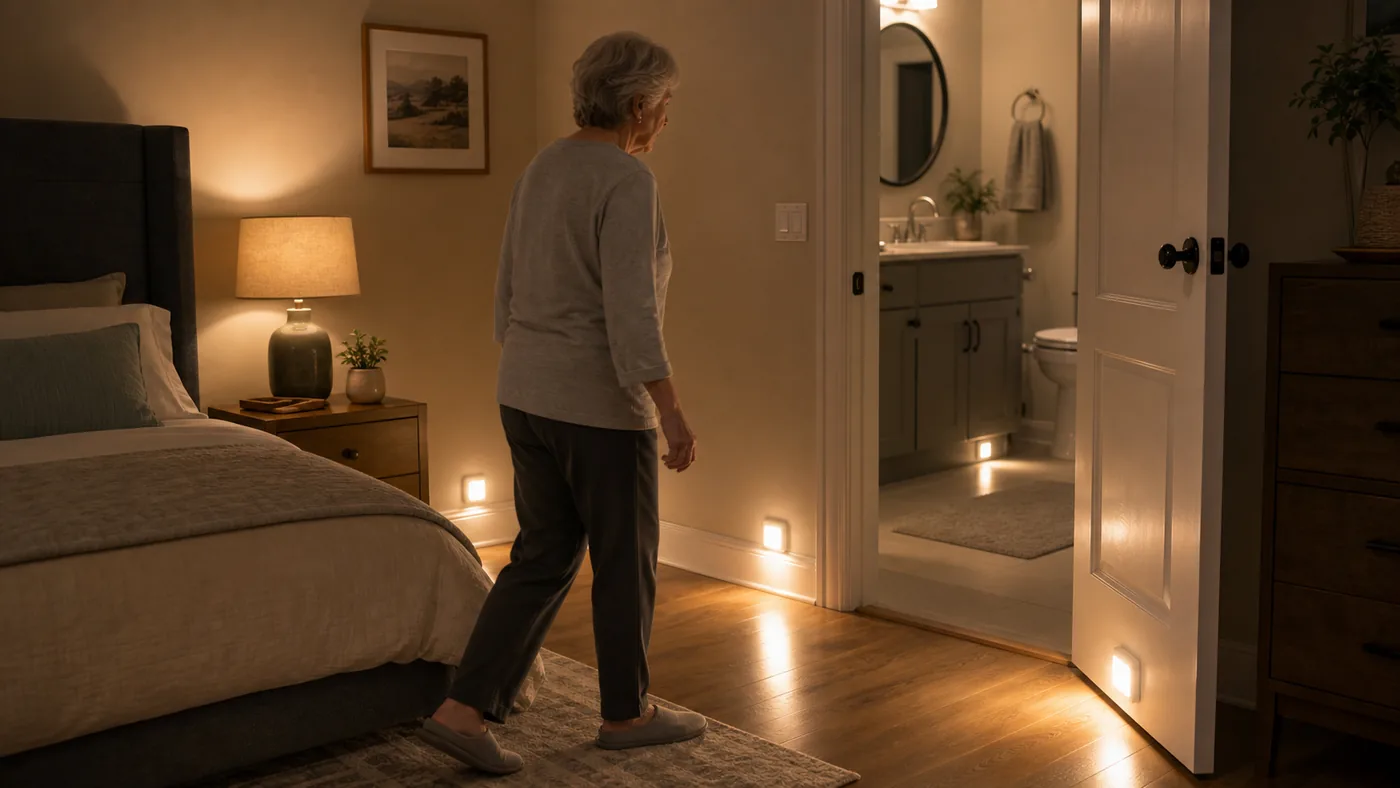
Use night lights as a path system, not single gadgets. Bedroom edge, hallway, bathroom entrance, toilet area, and stairs may each need different brightness and sensor behavior.
Walk the route at night. If the user squints, sees glare, or still cannot see the floor edge, the light is not placed correctly.
Night Light Types That Matter
| Type | Best for | What to check | Avoid |
|---|---|---|---|
| Motion path lights | Bedroom-to-bathroom routes and hallways | Sensor range, delay time, battery life, and whether light starts before the first step | Lights that activate only after the user is already in the dark area |
| Plug-in bathroom night light | Toilet trips and sink area orientation | Outlet location, brightness, color temperature, and glare direction | Blue-white glare pointed at eye level |
| Stair or step lighting | Split-level homes, stairs, and threshold changes | Even spacing, secure mounting, and visibility of step edges | Loose battery lights that can become trip hazards |
| Under-bed or low wall lighting | People who wake often at night | Low placement, warm light, and motion timing | Bright light that disrupts sleep or causes glare |
Motion path lights
Motion lights are helpful when they turn on early enough and guide the whole path. One light near the bathroom is rarely enough if the first steps from bed are dark.
Check before buying
- Sensor angle and detection distance.
- Battery or plug-in power.
- How long the light stays on.
- Whether it can be mounted without creating clutter.
Warm bathroom night light
A bathroom light should help orientation without blasting the user awake. Warm, low-glare light is usually easier to tolerate than harsh blue-white light.
Check before buying
- Outlet position.
- Brightness control.
- Direction of light.
- Whether the toilet, sink, and doorway are visible.
Step-edge lighting
Stairs need consistent edge visibility. A bright light at one end can still leave shadows that hide step depth.
Check before buying
- Secure mounting.
- Even coverage.
- No loose cords.
- No glare at eye level.
Placement Checklist
- Place the first light where feet touch the floor, not only near the bathroom.
- Use warm light where sleep disruption is a concern.
- Keep lights low enough to show the floor and edges without shining into eyes.
- Check batteries on a schedule if the lights are not plug-in.
- Retest after furniture moves, rugs change, or a walker/cane is added.
FAQ
Are motion night lights better than always-on lights?
Motion lights are useful when they activate early and reliably. Always-on lights can be better in areas where the sensor misses movement or where the user pauses often.
What color light is best at night?
Many people tolerate warm, low-glare light better at night. The best choice is the one that lets the user see the path without squinting or feeling startled awake.
Do night lights prevent falls?
They are one layer, not a guarantee. They work best with clear paths, stable footwear, bathroom support, and attention to medications or conditions that affect balance.
Where should I put the first night light?
Start at the bed and the first walking path. If the first few steps are dark, a bathroom-only light is too late.
What color light is best at night for seniors?
Warm amber light (like a 2700K or lower night light) protects night vision and makes it easier to fall back asleep; avoid white and blue-white night lighting.
Where should night lights actually go?
At every direction change on the bed-to-bathroom path, plus inside or at the bathroom door — motion lights in the bedroom aimed away from the bed.
Are battery strip lights reliable?
They work well for months but fade slowly; rechargeable ones need a calendar reminder, or they die silently at the worst moment.
2026 product decision layer
Night Light Products to Compare
The best night light is not the brightest one. It lights the route early, avoids glare, and does not add cords or loose edges.
| Candidate | Best fit | Why compare it | Watch before buying |
|---|---|---|---|
| GE/Enbrighten-style plug-in motion night light | Hallways and bathroom entrances with open outlets | Simple, low-maintenance, and no batteries | Outlet height, glare, sensor angle, and whether it blocks the second outlet |
| MAZ-TEK / similar warm plug-in dusk-to-dawn lights | Continuous low light where motion sensors trigger too late | Low cost and familiar for bedrooms, halls, and bathrooms | Brightness may be too much for sleep; avoid harsh blue-white light |
| Mr Beams-style battery motion lights | Closets, stairs, entry paths, and areas without outlets | Flexible placement without wiring | Battery replacement schedule and secure mounting |
| Under-bed motion strip kit | First step out of bed is the risky moment | Lights the floor before the person reaches the hallway | Adhesive failure, wires, overly bright strips, and sensor placement |
| Stair or step-edge path lights | Homes with steps between bedroom, bathroom, kitchen, or entry | Improves edge visibility where depth perception matters | Loose adhesive, glare, shadows, cords, and whether the light makes the edge clearer |
Best editorial recommendation
Start with a warm plug-in or motion light on the bed-to-bathroom path. Add battery or stair lights only where outlets are missing or step edges remain hard to see.