Senior Tech Buying Guide
Best Hearing Support Devices for TV and Phone Calls in 2026
Do not start by buying the most expensive hearing device. Start by naming the problem: TV volume, phone calls, group conversation, hearing in noise, or possible medical hearing loss.
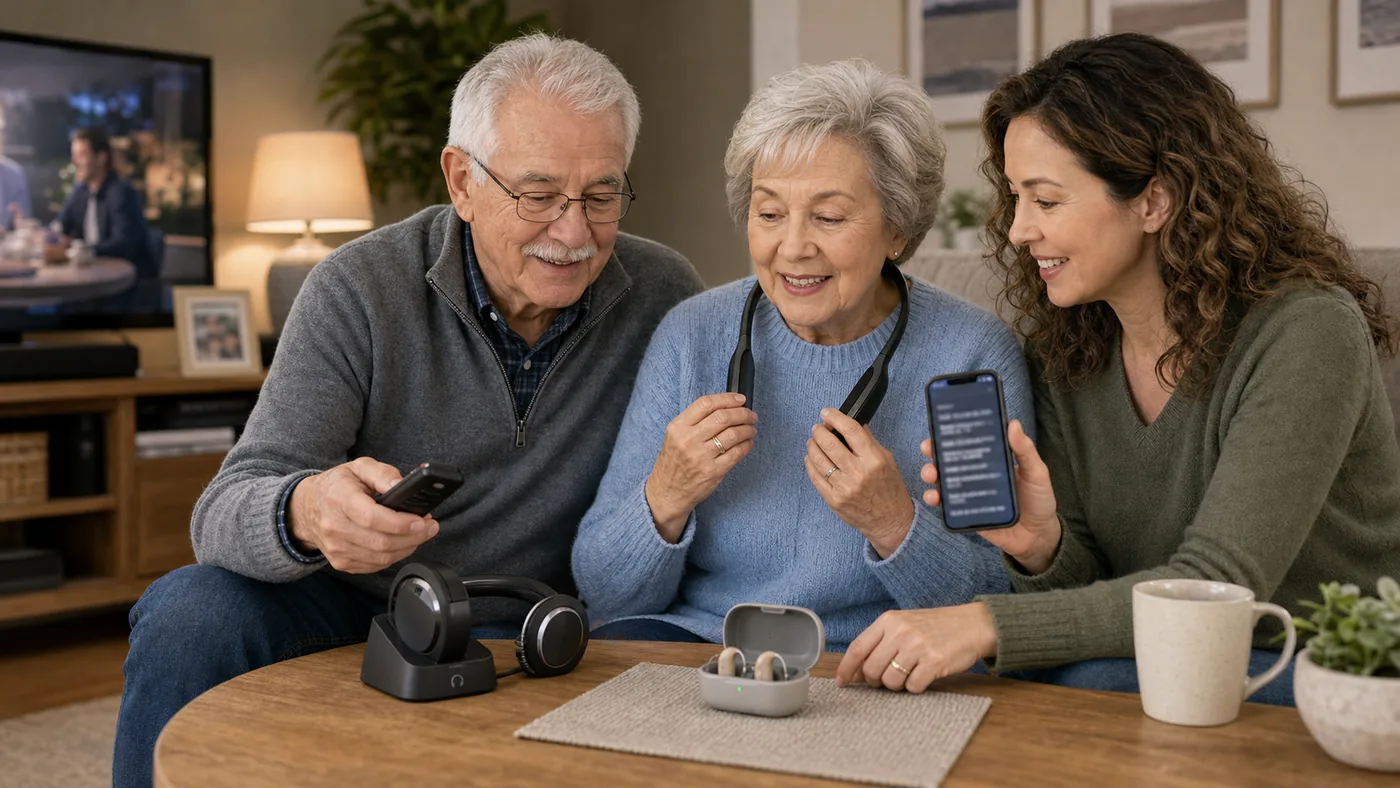
TV listeners, captions, phone accessibility settings, OTC hearing aids, prescription hearing aids, and PSAPs are not interchangeable. Match the tool to the listening problem.
OTC hearing aids are intended for adults with perceived mild to moderate hearing loss. More severe, sudden, one-sided, painful, or medically concerning hearing changes should be handled with a professional.
Pick by Listening Problem
| Problem | Best first direction | Why | Check before buying |
|---|---|---|---|
| TV is too loud for everyone else | TV listening system or TV headphones | Targets one activity without changing all-day hearing | TV audio output, charging dock, comfort, latency, and whether others can still hear the TV |
| Phone calls are hard to understand | Phone accessibility settings, captions, louder speaker, compatible earbuds, or hearing aid phone pairing | Often cheaper and easier than replacing all hearing equipment | Caption availability, Bluetooth comfort, call volume, and hearing aid compatibility |
| Conversation is hard in many places | OTC hearing aids or hearing evaluation | May address broader mild to moderate hearing difficulty | Return period, app burden, self-fitting process, support, and FDA category |
| Hearing changed suddenly or is severe | Hearing health professional | Could need diagnosis, prescription devices, or medical care | Do not rely on OTC devices for red-flag symptoms |
TV listening system
If the main complaint is TV volume, a TV listener may be the cleanest solution. It can send clearer audio to headphones or a neck speaker without making the whole room louder.
Check before buying
- TV audio output compatibility.
- Whether sound can play through both headphones and TV speakers.
- Charging routine and comfort for long sessions.
- Latency, especially for dialogue.
Captions and phone accessibility settings
Before buying a new device, test phone settings: louder call audio, live captions where available, visual alerts, hearing aid compatibility, Bluetooth routing, and favorite contacts.
Check before buying
- Whether the user can turn captions on without help.
- Bluetooth pairing stability.
- Battery impact.
- Privacy comfort with captioning services.
OTC hearing aids
OTC hearing aids may help adults who believe they have mild to moderate hearing loss. They are not the same as PSAPs, and they are not meant for children or people with more severe hearing loss.
Check before buying
- FDA OTC category and labeling.
- Return window and support.
- App requirements and self-fitting complexity.
- Red-flag symptoms that require a professional.
Buying Checklist
- Name the setting: TV, phone calls, restaurants, one-on-one conversation, or all-day hearing.
- Separate PSAPs from hearing aids: PSAPs amplify sound for people without hearing loss; hearing aids are for hearing loss.
- Check medical red flags: Sudden, one-sided, painful, draining, or rapidly worsening hearing issues need professional guidance.
- Test return windows: Comfort and sound quality are personal, so trial period and support matter.
- Plan maintenance: Charging, cleaning, wax guards, app updates, and lost-device routines can determine long-term use.
FAQ
Are OTC hearing aids right for every older adult?
No. They are intended for adults with perceived mild to moderate hearing loss. Children, people with severe hearing loss, and people with red-flag symptoms should seek professional care.
Are PSAPs the same as hearing aids?
No. The FDA distinguishes hearing aids for hearing loss from PSAPs, which are for people with normal hearing who want to amplify sounds in certain situations.
What should I try before buying hearing aids?
If the issue is mainly TV or phone calls, try captions, phone accessibility settings, TV listeners, and better speaker routing first.
What matters besides sound quality?
Comfort, charging, cleaning, app complexity, customer support, return window, and whether the user will actually wear the device.
Do TV hearing systems work with modern TVs?
Most do, but confirm the TV’s audio output (optical, analog, or Bluetooth) before ordering — this is the number-one return reason.
Is a soundbar enough for hearing loss?
A dialogue-mode soundbar helps mild difficulty in shared rooms, but once hearing loss is moderate, direct-to-ear systems outperform any speaker.
Can I get a captioned phone for free in the US?
Captioned telephone service is federally funded for eligible users with hearing loss, but equipment and provider rules change — verify current qualification.
2026 product decision layer
Hearing Support Products to Compare
Separate the problem first: TV, phone calls, group conversation, or broader hearing loss. Do not treat earbuds, PSAPs, TV listeners, and OTC hearing aids as the same product.
| Candidate | Best fit | Why compare it | Do not skip |
|---|---|---|---|
| Sennheiser TV Clear / RS-style TV listening systems | TV dialogue is the main frustration | Targets one room and one task without over-treating all hearing difficulty | TV connection type, charging dock, latency, comfort, and whether others can still listen normally |
| TV Ears-style headset systems | Simple TV listening with a dedicated headset | Purpose-built for TV volume separation and easier nightly routine | Fit comfort, battery, transmitter placement, and compatibility with newer TVs |
| AirPods Pro / modern earbuds with conversation and caption features | iPhone users who need help with calls, captions, or situational listening | Useful as communication support, especially when the person already uses Apple devices | Not a replacement for hearing aids; small earbuds can be easy to lose and require charging |
| OTC hearing aids such as Sony CRE, Jabra Enhance, Lexie, or Eargo-style options | Adults 18+ with perceived mild to moderate hearing loss | FDA-regulated OTC category may help some adults without a prescription | Return window, support model, app setup, fit, wax management, and red-flag symptoms |
| Professional hearing evaluation | Sudden, one-sided, painful, severe, or medically concerning hearing change | Shopping first can delay needed care | Do not frame any consumer product as diagnosis or treatment |
Best editorial recommendation
If TV is the only issue, start with captions, speaker placement, or a TV listener. If phone calls are the issue, test captions, volume, and headset options. If everyday conversation is the issue, compare OTC hearing aids only after reading FDA guidance and checking return/support terms.