Home Safety Buying Guide
Best Bed Rails and Bed Assist Handles for Seniors in 2026
Bed rails can help with transfers, but they can also create entrapment risks if chosen or installed poorly. This is a category where fit and safety warnings matter.
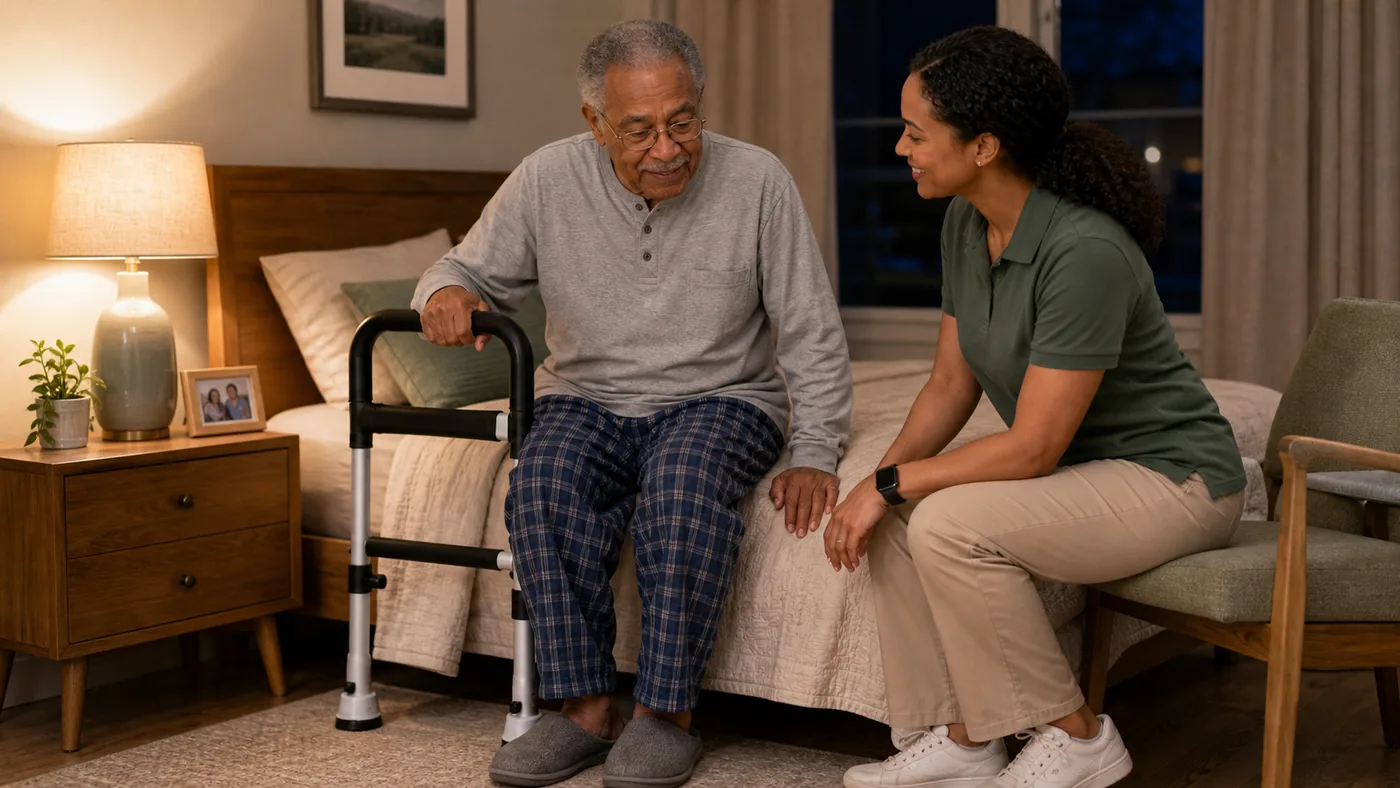
Use bed assist handles for a specific transfer problem, not as a default fall-prevention product. Measure the bed, mattress, and user movement before buying.
Entrapment, climbing, and poor fit are serious concerns. People with confusion, agitation, or unsafe bed movement may need professional guidance.
Bed Support Direction by Need
| Situation | Best direction | Why it helps | Check carefully |
|---|---|---|---|
| Needs help sitting up | Bed assist handle | Gives a handhold for controlled movement | Mattress fit, strap, gap, user strength |
| Rolls near bed edge | Clinical guidance and bed setup review | Rails can create risks if used incorrectly | Entrapment, climbing, confusion |
| Low bed transfer problem | Bed height adjustment or transfer aid | Height may be the real issue | Bed frame, floor clearance, footwear |
| Caregiver assists transfers | Transfer routine and handle placement | Reduces pulling on caregiver | Training, side access, nighttime lighting |
Bed assist handle
A handle can help someone push up or steady during sit-to-stand movement.
Good fit when
- The person understands how to use it.
- The mattress and frame fit securely.
- The goal is transfer support, not restraint.
Watch out for
Gaps and loose installation can be dangerous.
Bed setup review
Sometimes the safer fix is bed height, lighting, floor clearance, or a different transfer routine.
Good fit when
- The bed is too high or too low.
- Nighttime bathroom trips are hard.
- The person grabs furniture for support.
Watch out for
Do not add rails without checking how the person moves at night.
Professional input
Confusion, agitation, repeated falls, or climbing behavior changes the risk calculation.
Good fit when
- Dementia or delirium is involved.
- There have been bed falls.
- Caregivers are uncertain.
Watch out for
A rail can become a hazard if used as a restraint or climbing point.
Fit Checklist
- Measure gaps: rail, mattress, and frame spacing matter.
- Check mattress type: thick, soft, adjustable, or platform beds may not fit.
- Test movement: sitting up, turning, standing, and nighttime exit.
- Keep lighting nearby: bed exits often happen in low light.
- Watch for confusion: do not use rails as restraint.
FAQ
Are bed rails safe for seniors?
They can be safe for some transfer needs, but they can also create entrapment or climbing risks. Fit and user behavior matter.
Is a bed rail the best way to prevent falling out of bed?
Not always. The cause of the fall risk should be assessed first.
What should I check before buying?
Mattress fit, frame compatibility, gaps, installation method, and whether the person can use it safely.
Are bed rails safe for elderly people?
Used correctly they are transfer aids, not fall preventers. The risk arises from wrong fit, soft mattresses that create entrapment gaps, and use with advanced dementia where rails can act as restraints. Follow FDA entrapment guidance, ensure proper installation, and involve an occupational therapist for dementia cases.
Can bed rails be used on any bed?
No. Rails must match the bed type: adjustable and platform beds often need specific models, and mattress thickness changes how securely hardware clamps. Check compatibility before ordering, measure the frame, and reject any setup that leaves gaps between rail, mattress, and headboard.
What is the alternative if bed rails are unsafe for my parent?
A floor-to-ceiling grab pole next to the bed provides a stable handhold without enclosure. Bed canes offer a minimal push-off handle. Lowering the bed, adding non-slip flooring, and a nighttime motion light often address the underlying risk with zero entrapment concerns.
2026 product decision layer
Real Products to Compare Before You Buy
These are comparison candidates, not affiliate picks. Recheck current price, plan terms, coverage, and return policy before adding any buying link.
| Candidate | Best fit | Why it belongs in the comparison | Watch before buying |
|---|---|---|---|
| Medline Advantage bed rail or similar dual-purpose rail | Getting in and out of bed with balance weakness | Bed assist handle plus a fold-down rail; widely available through medical supply channels | Must fit mattress and frame thickness; check gap standards to prevent entrapment |
| Stander EZ Adjust bed rail | Adjustability as needs change | Width adjusts as mobility changes; doubles as a standing handle with a pouch | Installation onto platform or adjustable frames varies; verify weight rating |
| Bed cane with pocket organizer (Drive or Vive) | Minimal install for a mostly-independent sleeper | Simple single handle that answers the push-off need without enclosing the bed | Least restrictive but least fall protection; tips can shift on slick floors |
| Adjustable bed base with rails (temperature and position) | Couples investing in long-term sleep quality | Head and foot adjustment reduces the struggle of sitting up; rails add the safety arm | High cost; mattress compatibility; heavy assembly on delivery |
| Floor-to-ceiling grab bar rail (Stander Security Pole) | Rental homes and no-frame beds | Tension pole needs no bed attachment and provides a full-height grab point | Ceiling height limits; re-tension after moves; check padding for bare floors |
Price and plan terms to recheck before linking
- Bed rails are not fall prevention: they are transfer assistance, and used wrong they add entrapment risk. Occupational therapy guidance matters here.
- Rails and memory-foam mattresses interact: soft edges can undermine the handhold; test the combination before committing.
- Full rails for dementia patients require a doctor or OT discussion; restraint rules and entrapment standards apply.
Best editorial recommendation
Choose an adjustable dual-purpose rail for most balance-weakness cases, a floor-to-ceiling pole where the bed cannot take hardware, and involve an OT before any full enclosure rail.