Daily Living Buying Guide
Best Easy-On Shoes for Seniors in 2026
Easy-on shoes should solve bending and tying without creating a loose, unsafe fit. Convenience is only helpful if the shoe stays secure.
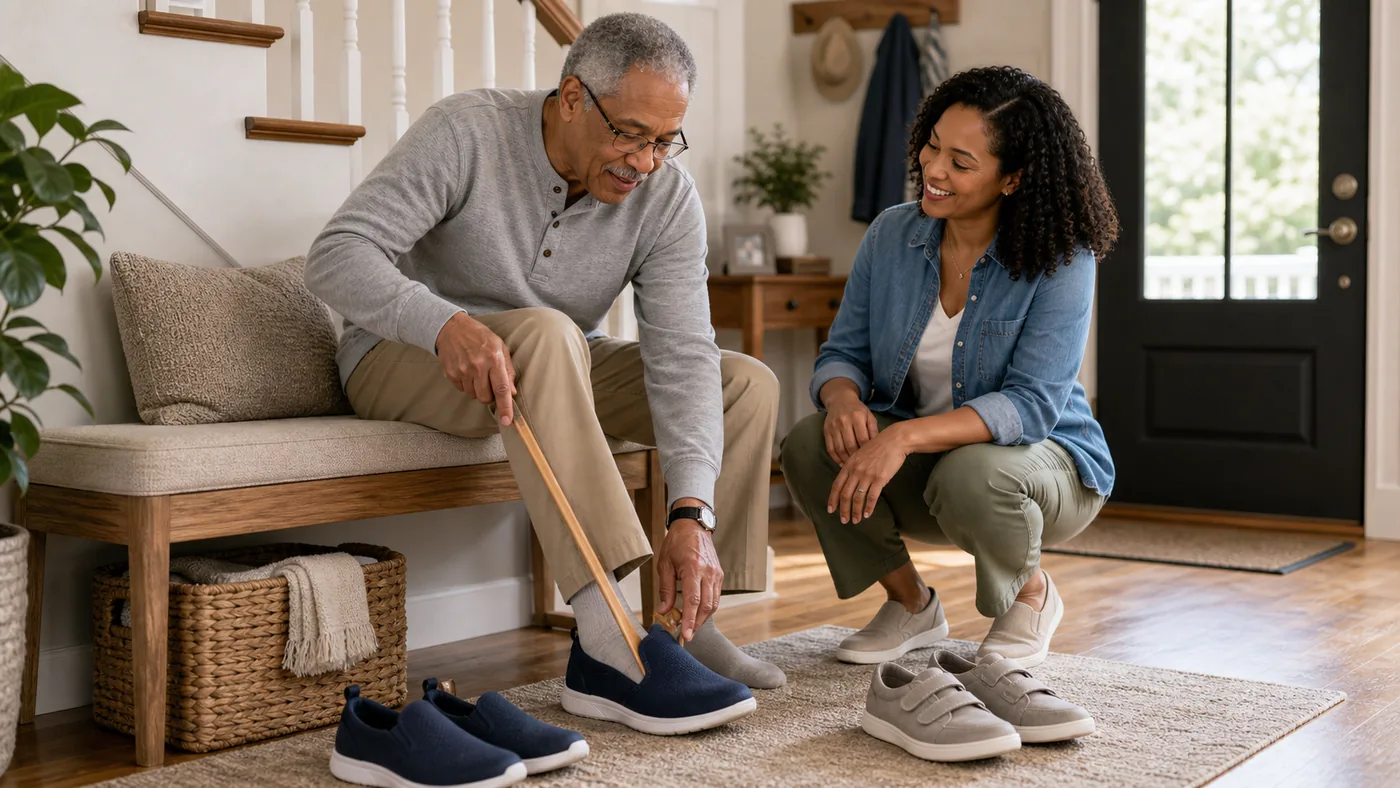
Look for easy entry plus heel stability. Hands-free or adjustable shoes can be excellent, but backless slip-ons are often a poor tradeoff.
Swelling, braces, orthotics, bunions, and hand pain all change the right closure type.
Easy-On Shoe Direction by Need
| Situation | Best direction | Why it helps | Check carefully |
|---|---|---|---|
| Hard to bend or tie | Hands-free or elastic-lace shoe | Reduces bending and knot tying | Heel hold, width, return policy |
| Swelling changes during day | Adjustable strap or wide sizes | Adapts to foot changes | Pressure points and secure closure |
| Uses orthotics or braces | Removable insole and extra depth | Makes room for support devices | Interior seams, depth, heel counter |
| Indoor use | Secure house shoe with back | Safer than loose slippers | Traction, washable material, heel support |
Step-in shoe with heel support
Hands-free shoes can preserve independence when bending is painful.
Good fit when
- The heel locks in securely.
- The user can step in safely.
- The shoe fits the usual walking surface.
Watch out for
If the heel slips, easy-on becomes easy-off.
Velcro or hook-and-loop closure
Adjustable shoes help with swelling and hand limitations.
Good fit when
- Feet change size during the day.
- Tying laces is hard.
- A caregiver helps occasionally.
Watch out for
Straps still need to close firmly without pressure.
Extra-depth shoe
Orthotics and braces need space without crushing the foot.
Good fit when
- The user has prescribed inserts.
- There are pressure spots.
- A wide toe box is needed.
Watch out for
Bring the orthotic when trying shoes.
Try-On Checklist
- Check heel slip: walk several steps, not just stand.
- Try at normal swelling time: afternoon fit may differ from morning.
- Use the real socks or orthotics: thickness changes fit.
- Test floors: tile, carpet, porch, and bathroom.
- Keep return packaging: fit problems often appear after a short walk.
FAQ
Are hands-free shoes safe?
They can be if the heel is secure and traction is good. Loose slip-ons are the concern.
Are Velcro shoes only for frail seniors?
No. They are useful for arthritis, swelling, braces, and anyone who wants easier closure.
Should easy-on shoes replace non-slip shoes?
The best pair should do both: easy entry and secure traction.
Are ‘non-slip’ shoe labels trustworthy?
No label is regulated for wet-tile grip; treat non-slip claims as marketing and check actual outsole reviews for the surfaces that matter in the home.
What shoes work for feet that swell during the day?
Elastic-upper slip-ons in wide width, fitted in the afternoon when swelling is at its worst.
Do diabetic feet need special shoes?
Yes — depth shoes with seamless linings and professional fitting; ordinary store shoes can create pressure points that become wounds.
2026 product decision layer
Real Products to Compare Before You Buy
These are comparison candidates, not affiliate picks. Recheck current price, plan terms, coverage, and return policy before adding any buying link.
| Candidate | Best fit | Why it belongs in the comparison | Watch before buying |
|---|---|---|---|
| Skechers GOwalk / hands-free slip-ons | Everyday wear, swollen feet days | Elastic uppers, machine-washable, wide sizes | Hands-free tabs wear out; soles smooth over a year of daily wear |
| Kizik / true hands-free sneakers | Limited hand dexterity or back flexibility | Genuinely no-hands entry, cage design holds shape | Premium price; style selection limited |
| Vionic / orthotic-support shoes | Foot pain or plantar issues | Built-in arch support, podiatrist-associated brands | Break-in period; not all styles come in extra-wide |
| Diabetic-friendly shoes (Propet class) | Diabetes or serious circulation concerns | Extra depth, seamless linings, fit accommodation | Usually medical-supply pricing; check Medicare/insurance coverage |
Price and plan terms to recheck before linking
- Non-slip claims are unregulated — wet-tile grip is not guaranteed by any marketing label.
- Swollen feet change size during the day: fit shoes in the afternoon.
- Diabetic feet need professional fitting; store shoes can create pressure points.
Best editorial recommendation
Hands-free designs (Kizik or Skechers slip-ons) for independence, Vionic-class support when foot pain is the driver, and professional fitting the moment diabetes is involved.
Choose the closure around the real obstacle
Match the Shoe Closure to the Daily Challenge
“Easy-on” is not one feature. The safest choice depends on what makes dressing difficult: bending, gripping, swelling, or fitting a brace. Start with the obstacle, then confirm that the heel stays secure while walking.
| Daily obstacle | Closure direction | What to test in person |
|---|---|---|
| Cannot bend comfortably | True hands-free step-in or a long shoehorn | Can the foot enter without crushing the heel, and does the heel lock in after ten steps? |
| Weak grip or painful fingers | Large hook-and-loop tabs or elastic laces | Can the wearer open and tighten it without pinching skin or needing a knot? |
| Foot size changes during the day | Adjustable upper with a broad opening | Does the closure allow room at the worst swelling time without letting the foot slide? |
| Brace, orthotic, or sensitive foot | Extra-depth shoe with removable insole | Does the device fit flat, with no seam or edge pressing on a sensitive area? |
Three safety checks after the shoe feels comfortable
- Walk and turn: test a normal hallway turn, not only a seated try-on. The heel should stay centered without gripping with the toes.
- Test the threshold: step over a small doorway transition and onto the main floor surface. A flexible upper is not a substitute for a stable sole.
- Check both feet again: remove the shoes after a short walk and look for red marks, rubbing, or numbness. Anyone with diabetes or reduced sensation should involve a qualified clinician or fitter.
More Buying Questions
What is the best closure for someone with arthritis in the hands?
Large hook-and-loop tabs or well-fitted elastic laces are usually easier than small eyelets and knots. The closure still needs enough adjustment to hold the heel securely.
Can a shoe be too easy to slip on?
Yes. If the foot slides out during a turn or the wearer must curl the toes to keep the shoe on, the opening is too loose or the shape is wrong. Choose heel security over the fastest entry.
When should a shoe fitting involve a professional?
Ask a podiatrist, orthotist, or qualified shoe fitter for help when diabetes, reduced sensation, a brace, a major foot deformity, or recurring pressure marks is involved.