Daily Living Buying Guide
Easy-Grip Kitchen Tools for Seniors with Arthritis (2026)
Quick answer: for most families, the top kitchen risks are falls, burns, and dropped pans — fix those first, then add easy-grip tools for the tasks that hurt most. Easy-grip kitchen tools are worth buying when arthritis makes opening jars, cutting, or lifting genuinely painful; before you spend, check the higher-risk fixes in our Home Safety Priority Checklist (free printable).
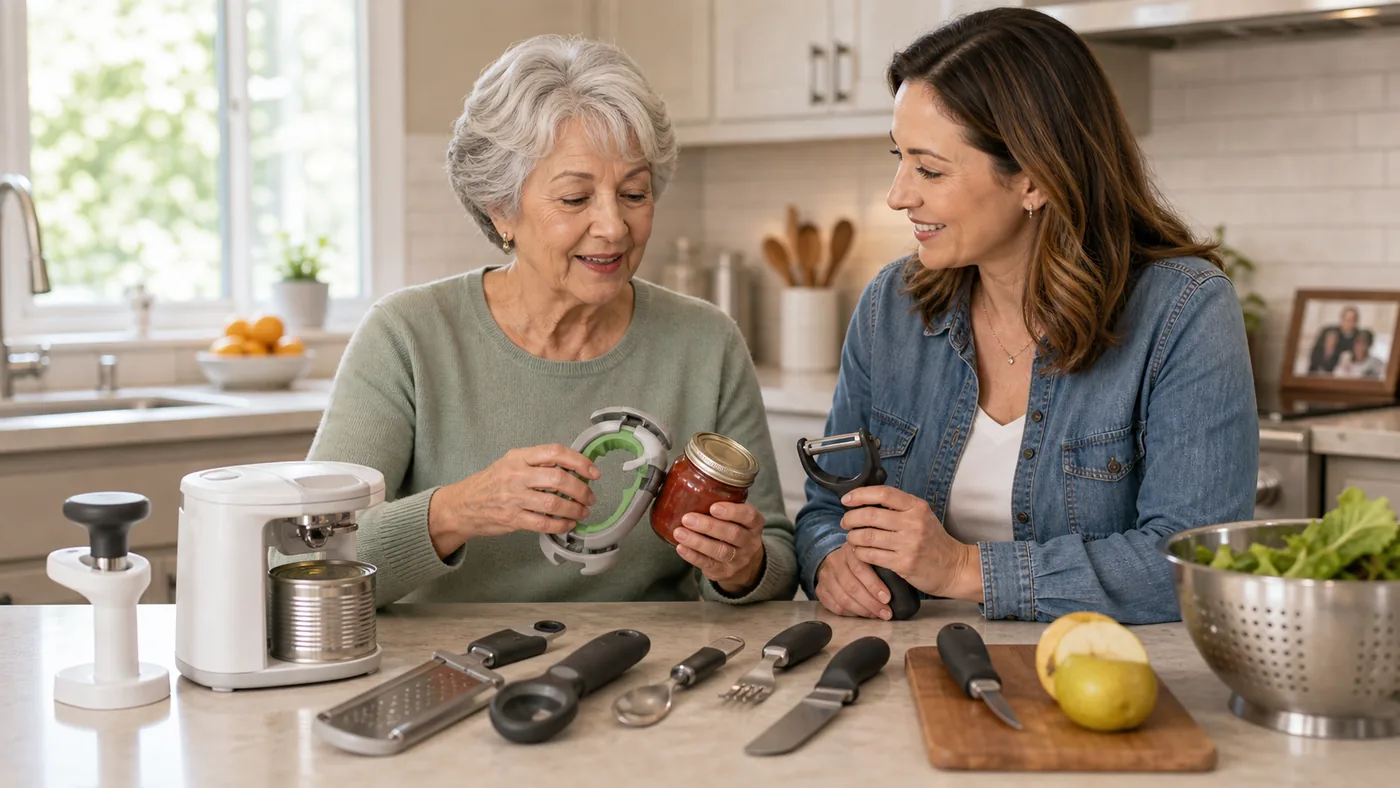
Buy by task: opening jars, cutting, stirring, lifting, or stabilizing. One universal arthritis tool does not exist.
Sharp tools, hot pans, and slippery counters can make hand pain more dangerous. Stability matters as much as grip size.
Kitchen Tool Direction by Task
| Situation | Best direction | Why it helps | Check carefully |
|---|---|---|---|
| Opening jars | Jar opener or under-cabinet opener | Reduces twisting force | Mounting, hand strength, jar size |
| Cutting food | Ergonomic knife plus stable board | Improves control | Sharpness, guard, board slip |
| Holding utensils | Large-handle lightweight utensils | Reduces pinch grip | Weight, dishwasher safety, balance |
| Can opening | Electric can opener | Reduces squeezing and twisting | Counter space, cleaning, lid safety |
Jar and bottle openers
Openers reduce twisting, one of the hardest motions for many arthritic hands.
Good fit when
- Jars are a daily frustration.
- Grip strength is limited.
- Counter or cabinet space is available.
Watch out for
Some openers need mounting or still require wrist force.
Stable cutting setup
A sharp ergonomic knife and nonslip board can be safer than forcing a dull tool.
Good fit when
- Food prep still matters.
- The user can cut safely with support.
- The board stays put.
Watch out for
Dull knives and sliding boards increase risk.
Large lightweight handles
Bigger handles can reduce pinch force during eating and cooking.
Good fit when
- Small handles hurt.
- The user tires quickly.
- Dishwasher cleaning matters.
Watch out for
Oversized tools can be awkward if too heavy.
Kitchen Tool Checklist
- Pick one painful task: do not buy a drawer full of tools at once.
- Reduce force: look for leverage, not just padding.
- Stabilize the work: nonslip mats and boards matter.
- Check cleaning: tools that are hard to wash stop being used.
- Retire unsafe workarounds: knives for jar lids and wet towels for grip can backfire.
How to Choose Kitchen Tools When Arthritis Makes Cooking Hard
Start with the motion that causes the most trouble. A tool is useful when it changes that motion, not merely when its handle feels soft.
| If the difficult task is | Look for | Tradeoff to check |
|---|---|---|
| Twisting a jar lid | A high-leverage jar opener with a stable base or mounting point | Some models need installation and counter clearance |
| Pinching a small handle | A large, contoured handle that can be held with the palm | Oversized handles may be hard to control for smaller hands |
| Cutting or chopping | A sharp knife, nonslip board, and a setup that keeps the food stable | Stability and safe storage matter more than a thick handle alone |
| Lifting a full pot | Smaller batches, lighter cookware, or a second-hand support strategy | No grip accessory removes the risk of a heavy hot load |
| Opening cans repeatedly | An electric opener if the user has safe counter space and can clean it | It adds a device to maintain and may not fit every can shape |
Match the tool to the user, not just the diagnosis
Arthritis affects people differently. A person with painful finger joints may need a palm-friendly handle, while someone with wrist pain may need less twisting and better forearm alignment. If grip strength changes from day to day, choose a setup that remains safe without maximum force. Test the motion with an empty or unheated item first.
Three checks before buying
- Can it be used without a tight pinch? The user should not need to squeeze hard to keep control.
- Can it be cleaned and stored easily? A tool that stays dirty or buried in a drawer will not help daily cooking.
- Does it reduce risk as well as effort? Avoid solutions that create a new hazard around sharp blades, hot cookware, or unstable counters.
More Questions Caregivers Ask
What is the best kitchen tool for weak hands?
There is no single best tool. Start with the task that causes the most pain or unsafe compensating behavior. A jar opener, palm-friendly utensil, or stable cutting setup may be more useful than a general collection of gadgets.
Are soft handles enough for arthritic hands?
Not necessarily. Soft padding can improve comfort, but leverage, handle diameter, balance, and stability usually determine whether a tool actually reduces effort.
Should someone with arthritis use an electric kitchen tool?
An electric opener can help with repetitive squeezing or twisting when it is stable, easy to clean, and simple to operate. It is not automatically safer if the user cannot control the item or handle the hot or sharp parts safely.
FAQ
What kitchen tool helps arthritis most?
The best tool depends on the task. Jar openers, stable boards, and large-handle utensils are common first choices.
Are electric tools worth it?
Sometimes, especially for can opening or repetitive tasks, but they need counter space and cleaning.
Should tools be heavier for control?
Not always. Too much weight can fatigue hands and wrists.